


 ไทย
ไทย

In today’s fast-evolving digital world, web applications must be designed to be ‘flexible, scalable, and easy to maintain.’ One of the most effective architectural approaches that enables this agility is the ‘Microservices Architecture’ — a modern design pattern that allows developers to build and manage complex applications in a more modular, efficient, and future-proof way.
What Is Microservices Architecture?
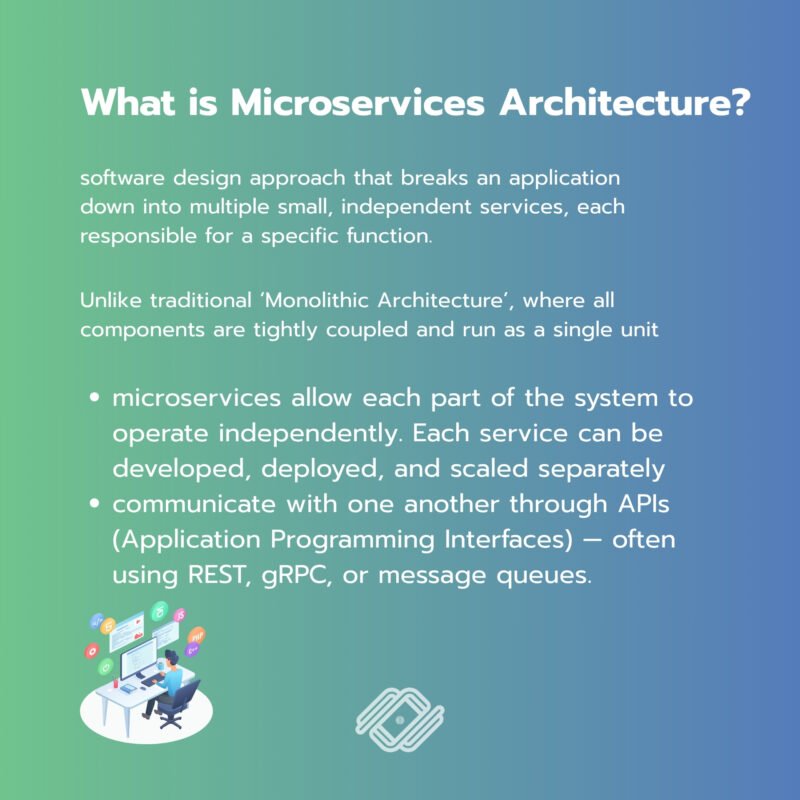
Microservices Architecture is a software design approach that breaks an application down into multiple small, independent services, each responsible for a specific function.
Unlike traditional ‘Monolithic Architecture’, where all components are tightly coupled and run as a single unit, microservices allow each part of the system to operate independently. Each service can be developed, deployed, and scaled separately, while still working together as part of a larger application.
These services typically communicate with one another through APIs (Application Programming Interfaces) — often using REST, gRPC, or message queues.
In essence, Microservices make a large system function as a collection of smaller, autonomous units that collaborate seamlessly.
Benefits of Using Microservices Architecture

- Development Flexibility
Each team can work on a specific service without waiting for others. This parallel development approach speeds up release cycles and reduces complexity in the codebase.
- Scalability
You can scale individual services based on demand. For instance, a payment service or user management module can be scaled independently without affecting the rest of the system.
- Resilience and Reliability
If one service fails — such as the shopping cart — other services like authentication or product browsing can continue to run without interruption.
- Simplified Deployment and Maintenance
Developers can update or redeploy specific services without shutting down the entire system, minimizing downtime and deployment risks.
- Technology Diversity (Polyglot Architecture)
Each microservice can be built using the most suitable technology stack. For example, Node.js for real-time communication, Python for analytics, or Go for high-performance services.
Examples of Microservices in Web Application Development
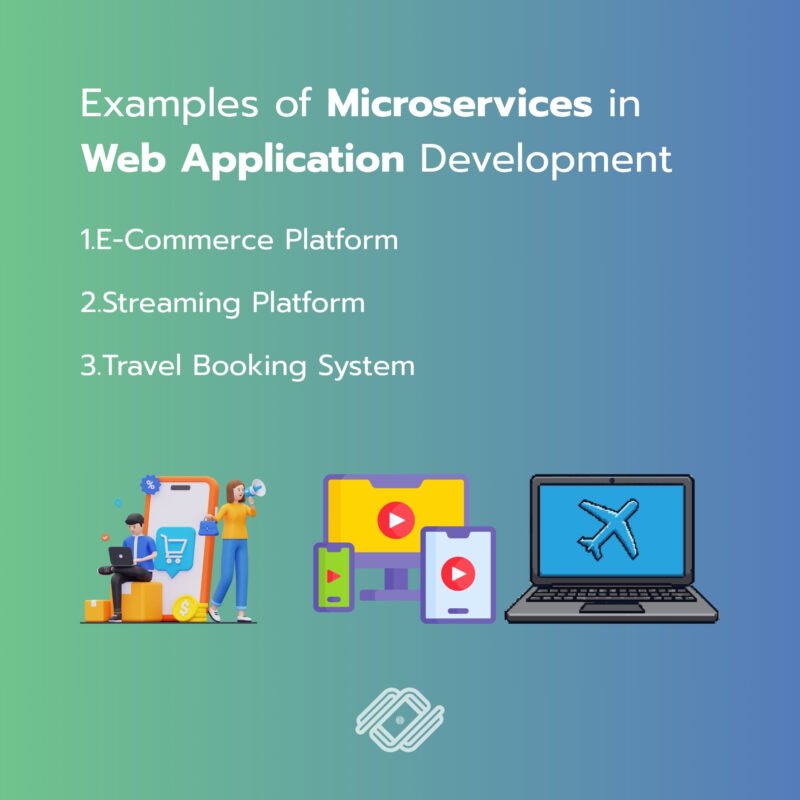
- E-Commerce Platforms
An online store can be divided into multiple microservices, such as:
- Product Service
- Payment Service
- Shopping Cart Service
- User Management Service
Each module operates independently, connected through APIs, enabling faster updates and better fault isolation.
- Streaming Platforms
A video or music streaming service can use microservices to separate functionalities like:
- User Account Management
- Recommendation Engine
- Media Processing Service
- Analytics and Reporting Service
This design allows the platform to handle millions of concurrent users efficiently without performance degradation.
- Travel Booking Systems
A travel booking platform can separate features like flight booking, hotel reservations, car rentals, and payment processing into distinct services. Each can be managed and scaled independently for better speed and security.
Conclusion
Adopting a ‘Microservices Architecture’ is a powerful approach for building modern, flexible, and scalable web applications. While it introduces more complexity in design and system management compared to traditional monolithic models, the long-term benefits — including faster innovation, easier maintenance, and greater resilience — make it well worth the investment.
In the era of rapid digital transformation, microservices provide the solid foundation businesses need to adapt, evolve, and scale with confidence.
Source: expert-programming-tutor.com
If you want your business to reach online customers and achieve sustainable marketing results, we are happy to provide consultation on what you need.
For further inquiries, contact us at:
Tel. 093 696 4498 Line OA: https://lin.ee/po8XduU
E-mail: mongkontep@pkindev.com
Inverz Solutions Co., Ltd. has received numerous awards for its achievements