


 ไทย
ไทย
In today’s digital era, almost every activity takes place online, and building a website is no longer just about communication — it also has a direct impact on the environment. Many people may not realize that websites have a carbon footprint. Each time a web page is loaded, servers consume energy to process, transfer, and display data. Much of that energy still comes from non-renewable sources that emit greenhouse gases.
The concept of an “eco-friendly website” has therefore emerged — promoting the idea of designing and developing websites that use digital resources efficiently, consume less energy, and contribute to a more sustainable digital ecosystem.
Sustainable Web Design
Sustainable Web Design refers to the process of developing websites with environmental responsibility in mind, considering energy use and resource efficiency throughout the entire lifecycle — from choosing a hosting provider and designing the interface to writing clean, optimized code.
A sustainable website doesn’t mean sacrificing quality or aesthetics. Instead, it combines efficiency, simplicity, and environmental responsibility. For example, using properly optimized images, selecting darker background colors that consume less power on OLED screens, or hosting websites on servers powered by renewable energy.
Guidelines for Sustainable Website Design
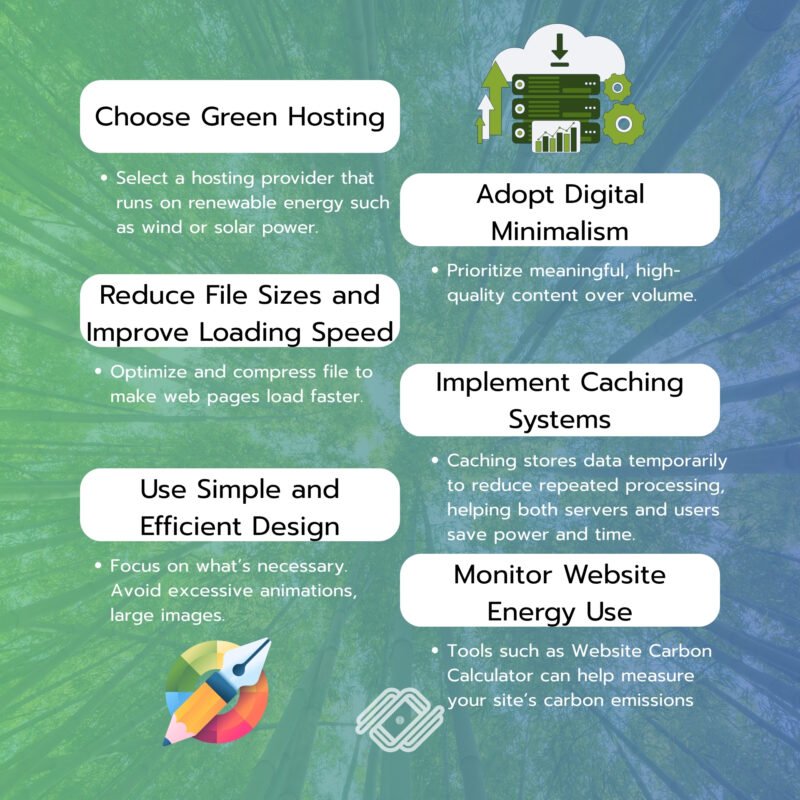
If you wish to make your website more environmentally friendly, here are several practical approaches to start with:
- Choose Green Hosting: Select a hosting provider that runs on renewable energy such as wind or solar power to reduce the carbon emissions generated by data centers.
- Reduce File Sizes and Improve Loading Speed: Optimize and compress files (e.g., images, CSS, JavaScript) to make web pages load faster. This not only saves energy but also enhances user experience.
- Use Simple and Efficient Design: Focus on what’s necessary. Avoid excessive animations, large images, or background videos that consume unnecessary processing power and bandwidth.
- Adopt Digital Minimalism: Prioritize meaningful, high-quality content over volume. A streamlined website helps users find what they need faster while minimizing energy use.
- Implement Caching Systems: Caching stores data temporarily to reduce repeated processing, helping both servers and users save power and time.
- Monitor Website Energy Use: Tools such as Website Carbon Calculator (https://www.websitecarbon.com/) can help measure your site’s carbon emissions and suggest improvements for greater sustainability.
Conclusion
Creating an eco-friendly website not only helps reduce energy consumption and environmental impact but also enhances your brand’s image as a socially and environmentally responsible organization. Sustainable web design is an essential approach for modern businesses that aim to grow responsibly while protecting our planet for future generations.
Source: bangkokbiznews.com
If you want your business to reach online customers and achieve sustainable marketing results, we are happy to provide consultation on what you need.
For further inquiries, contact us at: Tel. 093 696 4498 Line OA: https://lin.ee/po8XduU E-mail: mongkontep@pkindev.com
Inverz Solutions Co., Ltd. has received numerous awards for its achievements