


 ไทย
ไทย
As we approach 2026, the software engineering landscape is poised for one of its most transformative years. AI is becoming deeply embedded in development workflows, cloud architectures are shifting toward modular and serverless designs, and organizations are prioritizing sustainability and security at every layer. This article summarizes the 10 key technology trends expected to shape the year 2026 and highlights their practical implications for engineering teams.
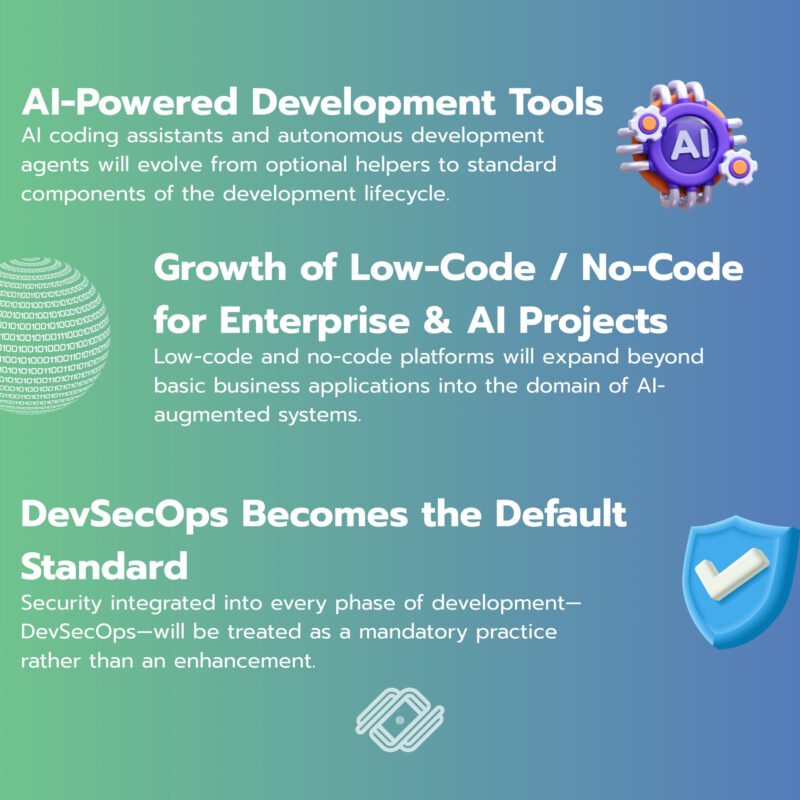
- AI-Powered Development Tools
Overview: AI coding assistants and autonomous development agents will evolve from optional helpers to standard components of the development lifecycle. They will contribute not only code suggestions but also automated testing, documentation, issue analysis, and architectural insights.
Implication: Organizations should establish governance for AI use, including data policies, review procedures, and code quality guidelines to ensure safe and consistent adoption.
- Growth of Low-Code / No-Code for Enterprise & AI Projects
Overview: Low-code and no-code platforms will expand beyond basic business applications into the domain of AI-augmented systems. Business teams will be empowered to build workflows, perform data analysis, and prototype AI-driven features without relying entirely on software engineers.
Implication: Define integration patterns, security controls, and an escalation pathway for converting critical low-code components into professionally engineered solutions when scaling is required.
- DevSecOps Becomes the Default Standard
Overview: Security integrated into every phase of development—DevSecOps—will be treated as a mandatory practice rather than an enhancement. Automated vulnerability scanning, security-as-code, and shift-left testing will be embedded into CI/CD pipelines.
Implication: Teams must adopt automated security tools, train developers in secure coding practices, and introduce threat modeling early in the development process.
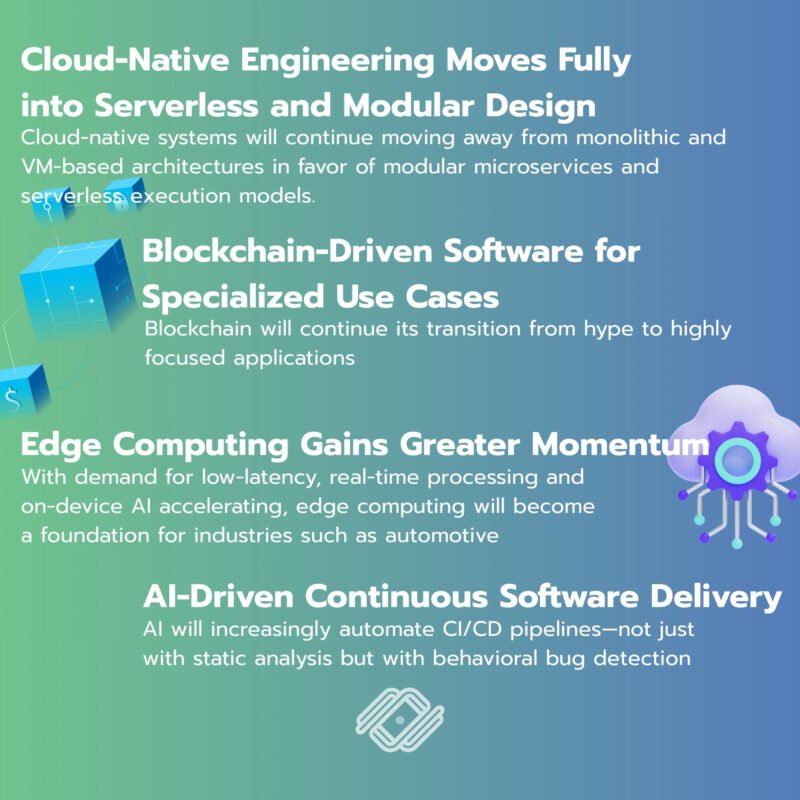
- Cloud-Native Engineering Moves Fully into Serverless and Modular Design
Overview: Cloud-native systems will continue moving away from monolithic and VM-based architectures in favor of modular microservices and serverless execution models. This shift enhances flexibility and cost efficiency but increases complexity in observability and state management.
Implication: Architects should design clear API contracts, enhance tracing/metrics/logging capabilities, and implement cost-optimization strategies across cloud services.
- Blockchain-Driven Software for Specialized Use Cases
Overview: Blockchain will continue its transition from hype to highly focused applications—such as audit trails, supply chain traceability, digital rights management, and automated financial workflows via smart contracts. It will not serve as a universal solution but will excel where trust, immutability, and transparency are essential.
Implication: Adopt blockchain only where consensus and tamper-proof records provide real value. Hybrid architectures (on-chain + off-chain) will help balance cost and scalability.
- Edge Computing Gains Greater Momentum
Overview: With demand for low-latency, real-time processing and on-device AI accelerating, edge computing will become a foundation for industries such as automotive, IoT, manufacturing, and smart cities. The expansion of edge data centers and edge-optimized AI chips will reinforce this trend.
Implication: Design distributed architectures that clearly separate workloads between edge and cloud, and implement robust update/patch management along with synchronization strategies for decentralized environments.
- AI-Driven Continuous Software Delivery
Overview: AI will increasingly automate CI/CD pipelines—not just with static analysis but with behavioral bug detection, automated validation, pipeline optimization, and intelligent rollback decisions. AI-guided pipelines will reduce manual intervention and support faster, safer releases.
Implication: Teams should prepare guardrails for AI actions, ensure auditability, and implement approval policies that balance automation with human oversight.
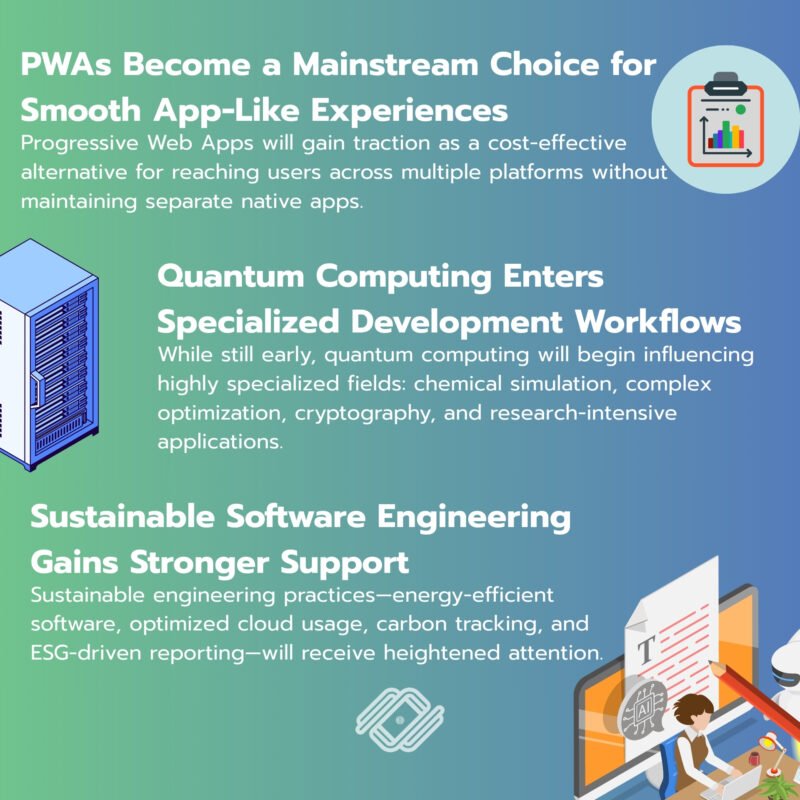
- PWAs Become a Mainstream Choice for Smooth App-Like Experiences
Overview: Progressive Web Apps will gain traction as a cost-effective alternative for reaching users across multiple platforms without maintaining separate native apps. With offline support, push notifications, and near-native UX, PWAs will become a preferred option for fast deployment and wide accessibility.
Implication: Start with a PWA for rapid time-to-market, and introduce native wrappers only when advanced hardware-level features are necessary.
- Quantum Computing Enters Specialized Development Workflows
Overview: While still early, quantum computing will begin influencing highly specialized fields: chemical simulation, complex optimization, cryptography, and research-intensive applications. Hybrid classical-quantum workflows will become more accessible through cloud-based quantum services.
Implication: Teams should monitor emerging quantum cloud services, build early proof-of-concepts, and invest in foundational knowledge related to quantum programming and quantum-safe cryptography.
- Sustainable Software Engineering Gains Stronger Support
Overview: Sustainable engineering practices—energy-efficient software, optimized cloud usage, carbon tracking, and ESG-driven reporting—will receive heightened attention. Organizations will adopt tools to measure emissions from compute workloads and optimize architectures for lower resource consumption.
Implication: Introduce energy monitoring, adopt efficient algorithms, reduce unnecessary compute cycles, and schedule workloads during green-energy windows where available.
Conclusion: What Engineering Teams Should Focus on in 2026
- Integrate AI into development workflows under structured governance.
- Combine low-code solutions with enterprise-grade architecture practices.
- Treat DevSecOps and automated security testing as mandatory, not optional.
- Move toward modular, serverless, cloud-native designs.
- Prepare architectures for distributed, edge-enabled processing.
- Begin experimenting with quantum technologies in applicable domains.
- Establish sustainability metrics and reduce energy usage across systems.
Source:
1.github.blog
- marketsandmarkets.com
- datadoghq.com
- thenewstack.io
- marketsandmarkets.com
- circleci.com
If you want your business to reach online customers and achieve sustainable marketing results, we are happy to provide consultation on what you need.
For further inquiries, contact us at: Tel. 093 696 4498 Line OA: https://lin.ee/po8XduU E-mail: mongkontep@pkindev.com
Inverz Solutions Co., Ltd. has received numerous awards for its achievements