


 ไทย
ไทย
In today’s data-driven digital economy, seamless system integration has become a critical factor in improving business efficiency and operational agility. One of the most important integrations for modern organizations is the connection between Web Applications and ERP (Enterprise Resource Planning) systems, which serve as the central hub for enterprise data and business processes.
Today, businesses rarely operate ERP systems in isolation. Instead, they increasingly connect ERP platforms with third-party systems such as e-commerce platforms, accounting software, CRM systems, warehouse management tools, and cloud services through APIs. This integration enables real-time data synchronization, minimizes redundant processes, and supports more accurate business decision-making.
The Importance of Connecting ERP Systems with Third-Party Platforms via APIs
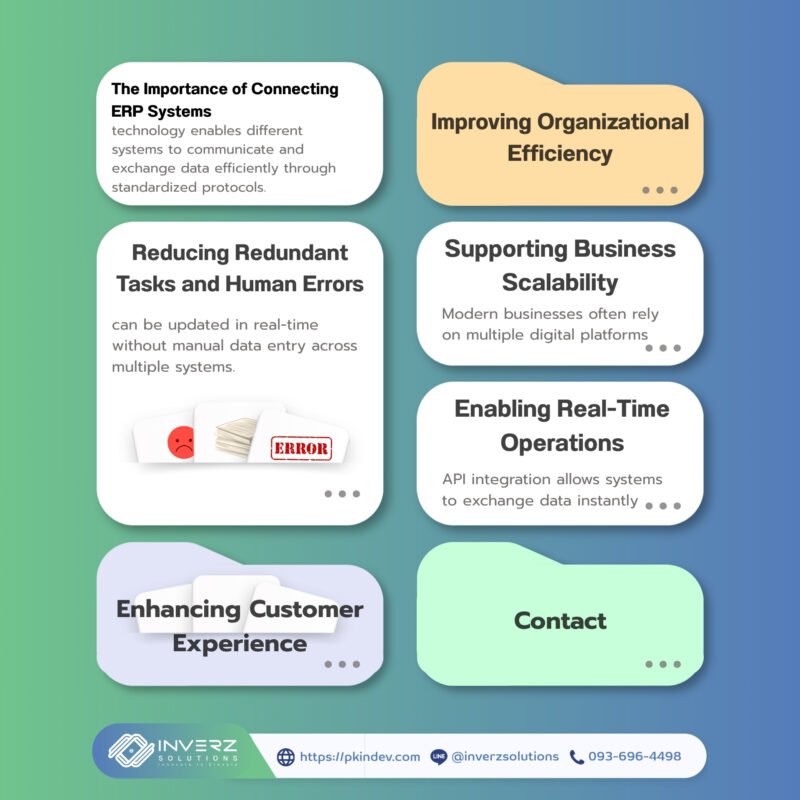
API (Application Programming Interface) technology enables different systems to communicate and exchange data efficiently through standardized protocols. Integrating ERP systems via APIs offers several significant advantages for businesses.
- Reducing Redundant Tasks and Human Errors
When sales systems, accounting platforms, and ERP software are connected automatically, information such as orders, inventory levels, and invoices can be updated in real-time without manual data entry across multiple systems. This significantly reduces human error and improves data accuracy.
For example, when a customer places an order through a website, the information can automatically be transferred to the ERP system to update inventory, generate invoices, and record accounting transactions instantly.
- Improving Organizational Efficiency
ERP systems centralize information across departments. API integration allows data from multiple platforms to be consolidated into a single source of truth, enabling management teams to monitor sales performance, inventory status, financial flow, and operational metrics more effectively.
- Supporting Business Scalability
Modern businesses often rely on multiple digital platforms, including marketplaces, payment gateways, logistics providers, and cloud-based services. API connectivity allows organizations to integrate new systems more easily without rebuilding the entire ERP infrastructure.
- Enabling Real-Time Operations
API integration allows systems to exchange data instantly, supporting real-time updates such as shipment tracking, inventory deductions, payment confirmations, and financial reporting. This helps businesses respond to operational changes and customer needs more quickly.
- Enhancing Customer Experience
When all business systems are fully connected, customers benefit from faster and more accurate services, including real-time product availability, automated documentation, order tracking, and seamless purchasing experiences.
Steps to Securely Connect a Web Application with an ERP API
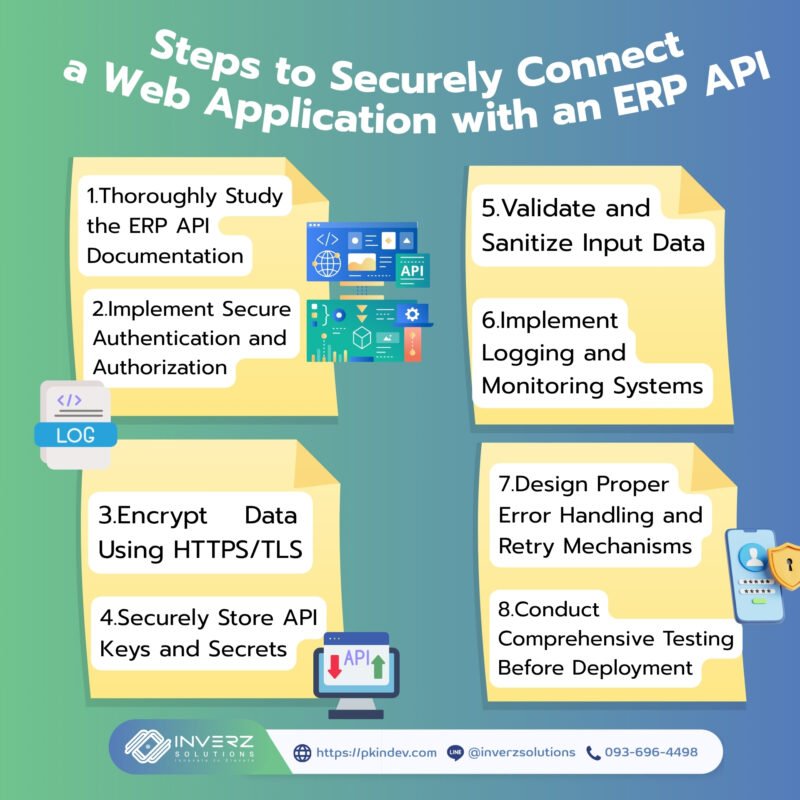
Although API integration improves business efficiency, poorly designed integrations may expose organizations to cybersecurity risks and data vulnerabilities. Therefore, integrating Web Applications with ERP systems should follow secure and structured implementation practices.
- Thoroughly Study the ERP API Documentation
Before development begins, developers should carefully review the ERP API documentation, including:
- Available API endpoints
- Request and response structures
- Authentication methods
- Rate limits
- Access permissions
A clear understanding of the API architecture helps reduce integration issues and security risks during implementation.
- Implement Secure Authentication and Authorization
Authentication is one of the most critical components of API security. Businesses should adopt secure authentication standards such as:
- OAuth 2.0
- API Keys
- JWT (JSON Web Tokens)
Additionally, role-based authorization should be implemented to ensure users and systems only access the data and functions necessary for their responsibilities.
- Encrypt Data Using HTTPS/TLS
All data transmitted between the Web Application and ERP system should be encrypted using HTTPS or TLS protocols. Encryption helps prevent data interception during transmission, especially for sensitive information such as:
- Customer data
- Financial information
- Passwords
- Authentication tokens
- Securely Store API Keys and Secrets
API keys and secret credentials should never be hardcoded directly into application source code, as this increases the risk of exposure. Recommended practices include:
- Using environment variables
- Utilizing secret management services
- Restricting access permissions
- Rotating credentials regularly
- Validate and Sanitize Input Data
Web Applications should validate and sanitize all incoming and outgoing data before sending it to the ERP system. This helps prevent security threats such as:
- SQL Injection
- Cross-site Scripting (XSS)
- Invalid data submissions
- Duplicate records
Input validation also helps maintain the integrity and reliability of ERP databases.
- Implement Logging and Monitoring Systems
Organizations should maintain comprehensive logging and monitoring systems to track API activity, including:
- API requests and responses
- System errors
- Unauthorized access attempts
- Usage patterns and traffic spikes
Effective monitoring allows IT teams to quickly detect and respond to abnormal activities or system failures.
- Design Proper Error Handling and Retry Mechanisms
API integrations may occasionally encounter issues such as network failures or ERP downtime. To improve system reliability, businesses should implement:
- Retry mechanisms
- Queue systems
- Error notifications
- Backup processing workflows
These measures help minimize operational disruption and improve system resilience.
- Conduct Comprehensive Testing Before Deployment
Before launching the integration into production, organizations should perform thorough testing, including:
- Functional testing
- Security testing
- Load testing
- Penetration testing
Comprehensive testing helps identify vulnerabilities, performance bottlenecks, and integration issues before the system goes live.
Conclusion
Integrating Web Applications with ERP systems through APIs has become a fundamental strategy for modern businesses seeking operational efficiency, real-time data synchronization, and scalable digital transformation.
However, integration convenience must be balanced with robust security practices, including strong authentication, data encryption, access control, and continuous monitoring. These measures are essential for protecting sensitive business information and ensuring long-term system reliability.
Organizations that successfully implement secure and efficient ERP integrations gain a significant competitive advantage through improved operations, enhanced data visibility, and superior customer experiences — all of which are essential for thriving in today’s digital business landscape.
Source: softnova.co
If your organization is looking for a comprehensive E-Tax Invoice solution with seamless ERP integration, we are a technology expert ready to provide tailored consultation and implementation services to meet your business needs.
For further inquiries, contact us at: Tel. 093 696 4498 Line OA: https://lin.ee/po8XduU E-mail: mongkontep@pkindev.com
Inverz Solutions Co., Ltd. has received numerous awards for its achievements